Women writing out of the shadows
April was the month that as as a writer I focused mainly on other people, other writers. It was rewarding, it was fascinating, and I learned a lot about something I suspected but was not sure I was imagining.
The matter at hand was about women’s writing in Gibraltar. I had this hunch that the bulk of media and academic attention goes on the men: Sanchez, Hernandez, Moreno, Durante et al. I’m not disputing that these should have plenty of attention; in fact, I would contend that in Gibraltar, there is an astonishing lack of attention to these talented authors whose works are illuminating, inspiring and stand the scrutiny of scholars internationally. That their work is not widely read and lauded in Gibraltar when they write Gibraltar, articulate our ‘Gibraltarianess’ to the world and stand as role models to aspiring writers, is nothing short of a cultural travesty. But this is a big subject in itself and it is perhaps better left to a detailed essay.
Yet I had a feeling that aside from the occasional appearance in the pages of the local press, or on a radio or TV chat, usually coinciding with an event or the launch of a publication, there is little to be heard from the women writers of Gibraltar.
This is a bit weird, I thought (one of my many inner monologues still speaks like a seventies teenager). I know numerous women writers, quite a few have published works to their name, I can find their books on the shelves of the local bookstore, I’ve seen the publicity around the launches in social media. Those launches are like mini firework displays: a little bit of fizz, a pop of colour to lighten up the literary darkness that lurks about the Rock, and then they fade away. Does anyone read these books? Does anyone talk about them? Does anyone really dig deep into them and openly discusses them? And, most of all, why do I feel this sense that Gibraltarian women authors are pretty much invisible?
So I got digging around the bits of information I could find. And what I discovered, so far (the data is very limited and I’m hoping to find out more), is that there is some justification for how I feel. Hear me out…
There are lots of Gibraltarian women writers who have published books. Many have written non-fiction (Alice Mascarenhas and Molly McEllwee to name just two). Others have written self-help books, autobiographies, cookbooks and children’s books. These are published and on book shelves. There are Gibraltarian women who have written thrillers (Audrey Alecio and Janine Galliano), fantasy (Theresa Caruana), poetry (Sonia Golt, Leyla Costa Gomez and others) and short stories (Rebecca Calderon). Others who may not have published full works have also been published in the local press, entered and won local writing competitions and had work published in anthologies (Mae Easter, Michele Attias, for example). But have women been the subject of the attention of the press or of academics to the extent that Sanchez and Hernandez have? Simple answer - no.
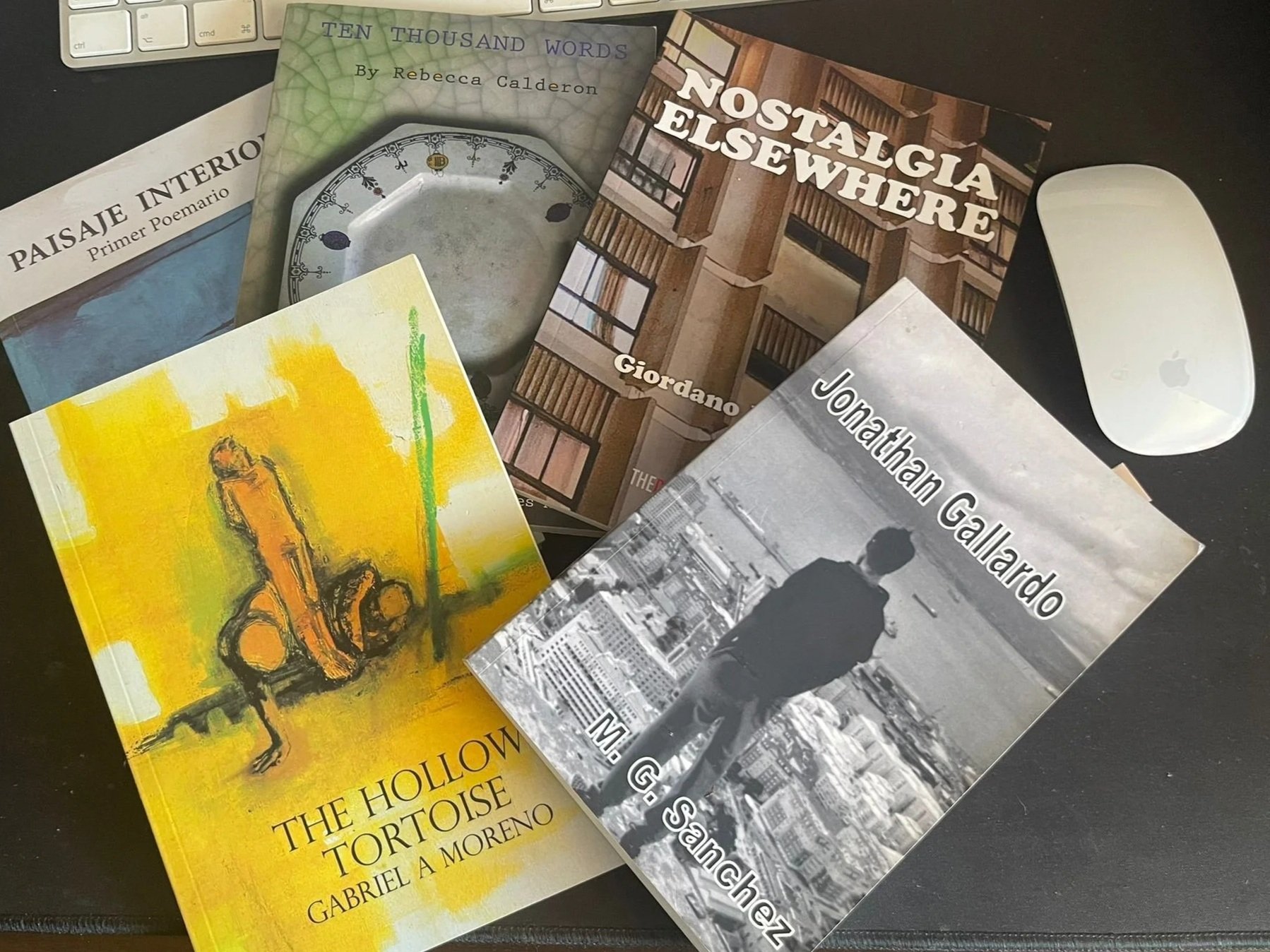
Some Gibraltarian fiction I think would be classed as ‘literature’. Only one woman writer, Rebecca Calderon with “Ten Thousand Words.”
The equally simple answer as to why that might be could be posited as being ‘their writing is not good enough’. And that would be wrong. Women’s writing is as good as if not better, but it is not visible and it is not visible because it is unlikely to have been published. Hernandez has published several books of a high standard of what we could call ‘literary fiction’. So has Sanchez and with him Giordano Durante and Gabriel Moreno. The women writers tend to either publish fewer works, and there are no doubt reasons for this phenomenon, such as a greater lack of confidence and more of the imposter syndrome among other structural issues that also mean there are fewer women CEO’s and political leaders in Gibraltar. To add to this, women writers at the moment tend to write in genres: romance, fantasy, thriller, romantasy etc. and genre fiction could fall outside the scope of what is generally termed ‘literary fiction''‘. Boundaries and definition of terms in themselves are contentious - genre writers should carry on writing their favourite genres because there is a readership for these and people should read what they want to read and write what they want to write without judgement. Literature in its narrowest sense aspires to something that is considered artistic and of lasting value. This narrows the scope for the inclusion of writing and it is within these narrow boundaries that Gibraltarian women’s writing is so limited.
Is it important for women to be better represented as creators of Gibraltarian literature? Definitely. Without the female experience in literature, our cultural identity as articulated in our written works remains stunted and unbalanced. Without visible women writers, women will not have the role models that will help them to aspire to publishing their work. Without having work published, there continues to be no visibility. The circle stays closed.
I put together some of this thinking, in a more coherent form, and presented it as a paper to the Gibraltar International Conference 4 held at the University of Cadiz last week (6th to 8th May 2026). When I have properly edited it, I will make it public and probably continue to observe this situation and add to my research on it. My overall conclusion is this:
Women writers in Gibraltar need to keep writing and keep improving their writing so we can develop and grow literature that people across the world want to read. We (this small and sometimes isolated group of us) need to feel seen, heard and supported by our local community and by each other. We write not just for ourselves; we write to be read. This means we have to have the courage and the means and the opportunities to publish our writing. Women writers need to feel included and supported in this; they should not feel left behind, but they should now strive to emerge from the shadows and have the confidence to allow people to read their work, and to comment on it and to share it and to learn from it.
Do you have an opinion on this? Reach out on my contact page and share it with me. Or send me a private message on my social media - more than happy to debate this, and more than happy to learn from your experiences if you are a Gibraltarian woman writer.
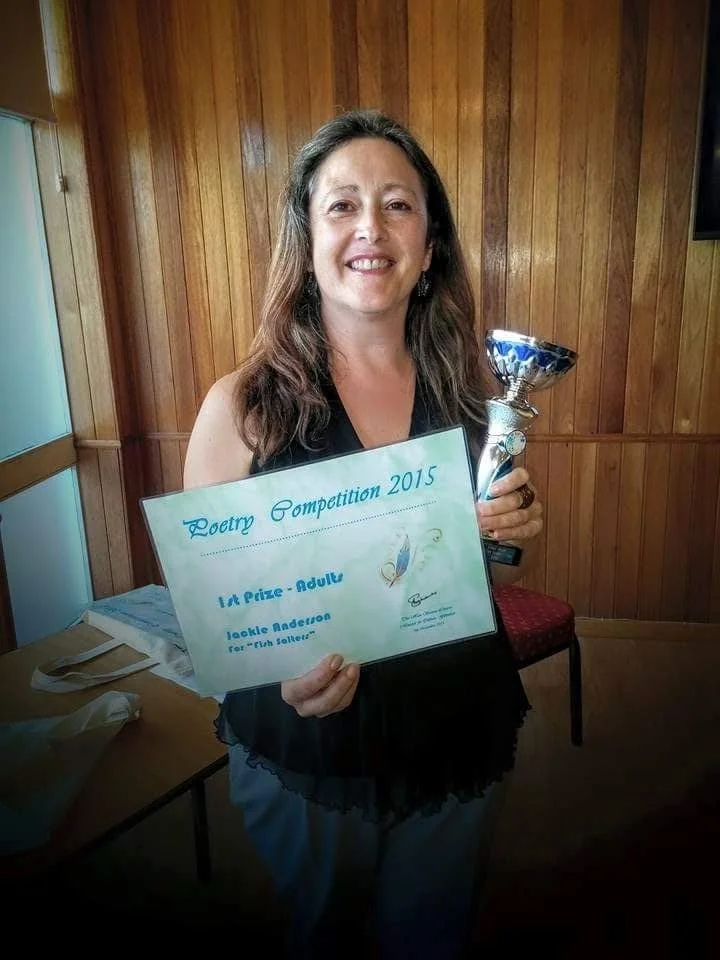
Not a great photo but I’m quite proud of that moment. “Fish Salters'“ has been published in a collection of my work and in an anthology of local poetry. The best bit about this? That people out there in the big wide world read my poem.