The Power of the Spoken Word
I am very much a late-comer to spoken word events as a performer. Here I am in my early 60s and I think my debut proper, other than a couple of isolated readings at more formal events in the past dozen or so years, was at the University of Basel last year. It was an informal gathering of delegates who attended the Gibraltar International Conference 3.
I was nervous, inexperienced, making my choice of poems literally as I walked up to the mic knowing that I was being followed by the star acts that are Jonathan Teuma, a veteran and champion of Poetry Slam Madrid, and by Gabriel Moreno, a veteran of folk music and performance poetry. At least, I thought, as I headed for the spotlight, my little ditties could be got out of the way quickly and then the audience could get on with the real performances, starting with a dramatisation of a scene of one of Rebecca Calderon’s plays. Miraculously, I didn’t trip over en route to stage, the mic worked, expectant faces turned towards me…and I was hooked. It helped that they clapped and sighed and oo-ed and aa-ed and laughed at all the right places and actually cheered at the end; they were a kind audience.
Since then I have given much more thought to the value of spoken word events and the performance of poetry. I’m a pretty solitary sort of person, still quite shy, still waiting to become confident like grown ups are confident. I enjoy my own space and my own company and don’t readily seek out opportunities to socialise. I have attended open mic events, slam poetry events, recitals and readings, and story-telling sessions and have always enjoyed them, but pluck up the courage to ‘perform’ a poem? Not my scene, I thought.
On a slight tangent, the best story-telling session I ever attended was at a Saxon and Viking day in Kent many years ago. There were stalls and reenactments and there was armour and archery and swordfighting and all those events that this history nerd loves and luckily also entertained the kids. There was lots of mead as well, I remember, and it was a hot summer’s day and the field was lined with bales of hay and the air buzzing with bees. It genuinely was that idyllic. I took the kids into the story-teller’s booth and we all sat on bales of hay, kids and adults alike and listened to the stories. Sounds childish but it was an hour of absolute wonder. The story teller was a huge beardy Norwegian chap, his grey hair falling over his shoulder in long braids long before the TV show made it fashionable. He spoke in a soft voice, but despite the thirty or so people around him, he didn’t have to raise his voice because we were all mesmerised. The tales of the Norse gods and the heroes became real in the shade of that booth. And that was before I had found the beer tent and imbibed the mead.
The point I’m rather clumsily trying to make is how powerful the spoken word is. Stories came to us through the power of the human voice and the strength of the breath. I understood in that Viking story-teller’s booth just why we talk about ‘breathing life’ into things, or how ‘in the beginning was the word’ refers to the creative power of the spoken word. It dawned on me then why some ancient societies did not speak the real name of a person but gave them nicknames, because to speak someone’s name could diminish their power, as in the old story of Rumplestilskin.
For those of us who dabble in stringing words together and have the audacity to call them poems, sharing them with others by speaking those words we put together gives them shape, rhythm, meaning, strength. It is as if by speaking out the poem that you are finally giving it life, allowing it to fly the nest as it were, and make its mark on the world. Perhaps that’s why poets are as protective of their poems as they might be of their young.
Which finally brings me to Native Tongues, the spoken word, almost-monthly event that takes place here in Gibraltar. It was started up by poet and lyricist, James the Heartist (James Ablitt), and poet, Jonathan Teuma who, as mentioned, is a champion slam poet, a published poet, and his rap lyrics are brilliant. Native Tongues is one of those rare, safe spaces where the guest poet gets a chance to showcase their work, which in poet-language means trying out the rhymes and rhythms of your work properly, testing the imagery, the narrative arc, the emotional impact on actual humans (I often test on my cats and on Mr Anderson, all of whom have a tendency to yawn and stare blankly back at me). And if you’re not the guest poet, that’s okay because it is also a chance to take your place in the open mic sessions and try out your latest creation. The audience is generous, mostly poets, rappers and song writers, all equally nervous and trying out their own work. Feedback is meted out over beers in the intervals, connections are made, and most important of all, stories exchanged.
Here are Jonathan and James explaining it all, courtesy of GBC via YouTube:
https://youtu.be/WgtNFXWo2g0?si=xtXaMaco3ZrQflwV
Native Tongues is a return to our roots as humans, a place and time where we exchange tales that entertain, inform, explore, fascinate and which make us feel that the electronic, synthetic, doom scrolling fug that the world has become can change, that we can reach out and connect human to human, word by word after all.
So this makes Native Tongues not just a monthly poetry event. It is a space where those with the impulse to create stories and tell these in song, lyrics, poems and tall tales, can breathe new life into our day to day existence, can learn, can grow, can find their voice and their place. It is far, far bigger than it seems at first glance.
If you haven’t been to a Native Tongues event yet, you’d do well to catch the next one, on June 18th where Jonathan Teuma will be hosting, the guest is brillian singer songwriter, Adrian Pisarello and the mic will be available to pick up Seriously do not miss it. Turn up at the MAG club at 14 Wellington Front at 7.00pm that evening, pick up some beers from the bar (or whatever your favourite bevvy might be) and settle to some brilliant, free entertainment. And bring a couple of your verses with you, just in case you, too, feel the need to get your words out into the world.
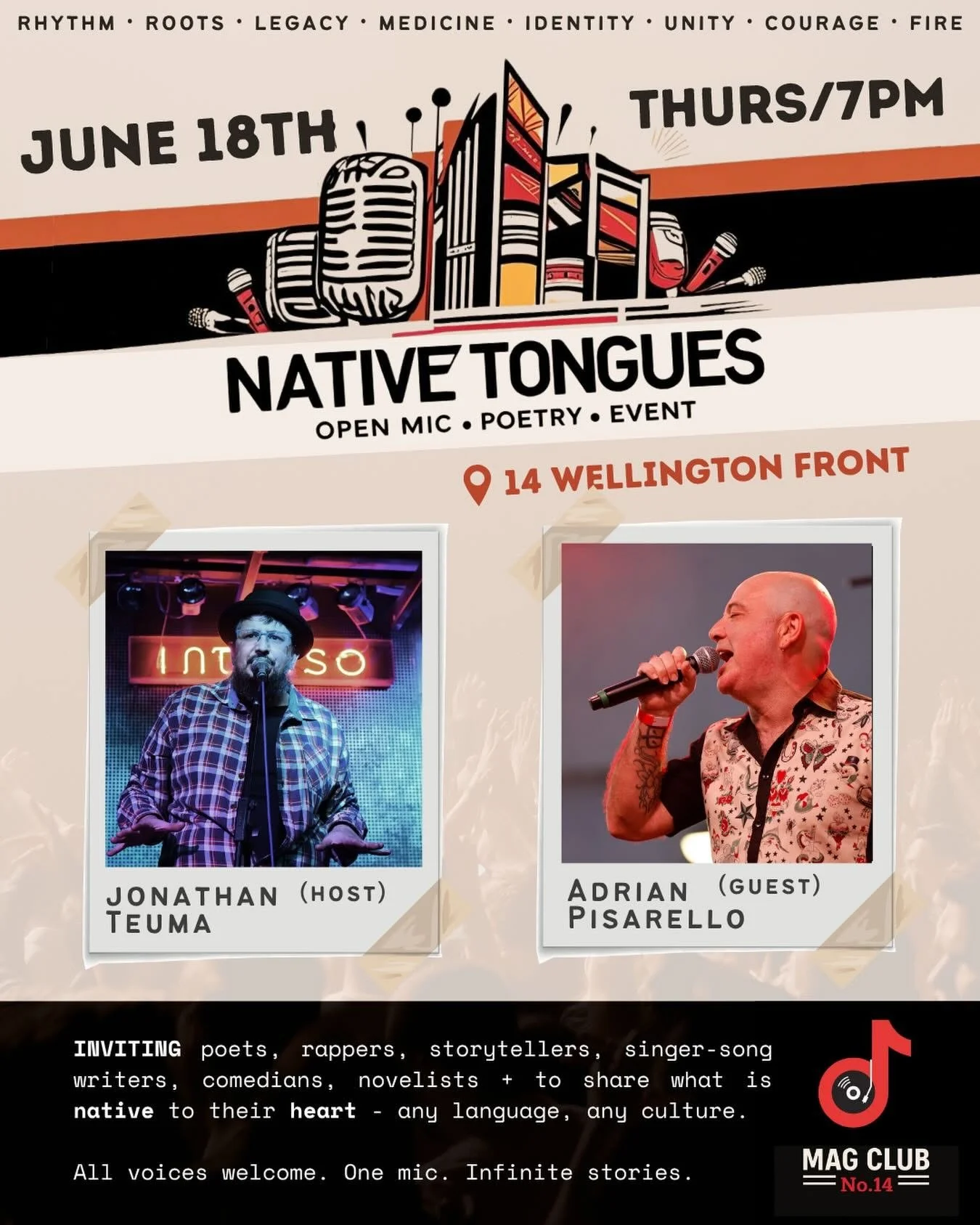
Native Tongues - midsummer version: unmissable!